Monday, August 15, 2011

POST-MORTEM ON HOSPITAL HELL


MAROONED IN COSTLY LIMBO

It's been more than 40 years since Canadians faced ruin because of medical bills. It used to be a spectre  over every family.  But ever since medicare began in 1966, we no longer have to worry.
Or do we?
What about parents whose kids ignore the health ministry's reminder about travel insurance and head for Florida beaches for spring break? What about Snowbirds who skip insurance because of the hefty premiums when they flee winter?
If you're lucky, the hospital bill will be only $70,000! I know, because that's what a mere nine days in  West Virginia hospitals cost before the $12,000 air ambulance trip to the hostile reception at St. Joseph's Health Care Centre.
Fortunately Mary and I were insured. Green Shield covers me for a month out of the country. We were covered for a second month by travel insurance costing $626.
Yet I have friends who gamble and go naked of protection. As I write, one is on a quick trip south and couldn't get insurance because of a problem after a recent cruise. There are cases where insurance bureaucrats refuse to pay because they claim questions about "pre-existing questions" were fibbed.
One point of my Sun "hospital hell" series was that we are being robbed of proper care by inadequate staffing and "restraints" even though OHIP takes 43% of the provincial budget.
E-mails from readers support that, as did the recent Canadian Medical Association study saying "the once proud system is in distress." Sounds like a broken record! How many studies do we need into the frustrating, miserable, even dangerous, condition of medicare? (For dismal reading, look at the report on CMA.ca.)
 I got a response from Health Minister Deb Matthews about my costly delay in getting home. Matthews conceded to me that "there is a gap and we are working to address it. "
 She argues the "vast majority" get back without much difficulty "but partly in response to your stories and some others," she has asked the Ontario Medical Association to work with reps from the hospital association, travel industry and her critical care secretariat to develop a new protocol. "We can do better," she says, if patients anxious to get home are not dealt with on an individual basis.
Of course the insurance industry has a huge stake in speeding our returns. But so have Canadians. Readers have told me they only got a relative home because a relative working in the Ontario hospital fought from the inside. They've said Canadians in the U.S. are at the bottom of  wait list because they're already being treated.
Liz Potash wrote me that Matthews was only one of the leaders she contacted in the two-month fight to get her husband back from Florida last year. The ordeal stunned them. "What is happening to our system when a citizen is gravely ill and not one single bed in any hospital in Ontario can be found," she wrote.
Exactly the same was written to me by Laurie Leveille who says the average Canadian doesn't recognize the "insanity" in medicare unless they have to endure it "kicking and screaming." Her late son spent terrible months in Mexico before, in awful irony, a Florida hospital agreed to take him. The struggle to get him into the Niagara Health System took seven months.  (The system has just been placed under a provincial supervisor because of merger problems and a deadly outbreak.)
Several readers wondered why I wrote about costs because they said their private insurance paid almost everything that OHIP didn't.  As if we don't pay for OHIP through our taxes. As if we don't pay directly or indirectly for private insurance. My premiums for the Sun plan for retirees is $390 monthly, rising from the $266 I paid in 2008 because of what administrators said were high health costs.
 Green Shield may have paid $4,660 of the $6,450 bill that St. Joe's charged me, but bills like that are the reason my premiums jump.
You may ask for a semi-private room but you will be charged the higher fee for private if you are in intensive care or the hospital claims semi-private wasn't available. Yet the main bill isn't the end of it. I paid another $658 at St. Joe's.  Hospitals today are more efficient at picking your pocket on incidentals than in answering your call button at 3 a.m.  So you pay $75 a month for phone service, and have to provide the phone. You pay for TV even when it doesn't work.  Runnymede charges $60 monthly for laundry, even if you don't use it. And it billed me $3,333 in advance. Unfortunately, it still hasn't given me a full accounting.
It hasn't been an easy return to health from my admission to the first of four hospitals on, appropriately, April Fool's Day.
I have had plenty of down time to reflect on the costs and tribulations since I have daily visits from a community nurse for the bed sore wounds. They may continue for months and certainly cripple my movements and summer. But I thank heaven, and you should too, because the Community Care Access Centre means I can be at home and not in hospital with its costs. You and I as taxpayers would have saved a lot if only those deep ulcers hadn't been allowed to dig in so evilly.
There is a humorous side, but then I have to search hard to find it. I have had months of daily inspection of my bottom by nurses. I laughed when Dr. Franklynne Vincent, the friendly dermatologist who is the wonderful weapon against wounds at St. Joe's,  admired how the wounds were healing. I said I had waited  60 years for a woman to admire my bum but the eroticism was ruined by the setting.
It's an interesting start to my daily routine to have a woman come to my bedroom and start tweaking and patting my bottom.  It almost makes up for Vincent and a plastic surgeon who twice have cut flesh away  so a "vac" can be inserted to drain the wounds.
 Now I have to carry an awkward three-pound vacuum box around my neck and lots of tubing every bloody second of the day and night.  If only it was filled with rum. That might ease my gloom over the last months and my fear that despite all the political rhetoric and CMA studies, the only thing that will change will be ever higher costs.

Monday, August 1, 2011

ANOTHER TALE OF NEWSPAPER WARS


BEATING THE STAR WAS BETTER THAN SEX...ALMOST!

 Many Torontonians don't realize they live in one of the best and most competitive newspaper cities in the world.
The paper wars continue even though the fiercest, the storied past of the hand-to-typewriter combat of the Star vs. the Telegram, has ended because of the Tely's death in 1971. As a bloodied participant, I can assure you that it was far more intense, and more fun, than any Hollywood movie.
There weren't as many fist fights between the champions of the big two dailies by the time I arrived as a kid reporter in 1958.  Not that bare knuckle disagreements had ended. There were several dandy ones between my colleagues, one right by the city desk which was ignored by everyone, including the chap who had been knocked flat. The press club had a few brawls fueled by booze and egos.
But we sure fought it out in print edition by edition five times a day. You could be a champ with your Page One scoop at noon and by the final edition, a chump because the Star beat reporter had been driven through the tongue-lashing of the city editor to find an even better story.
Peter Worthington, who seems to have been writing since Biblical days, gave us a wonderful account of the Tely-Star brawls in a column in the Sunday Sun on July 30. The apt headline: "When Newspapers And Reporters Slugged It Out."
I got an early introduction to the fact I had enlisted in a tough trade when I was assigned to go with a bulldog of a photographer named Don Grant to cover a Teamsters' strike. The picketers cursed us as we approached and one threatened Grant. Grant said: "How would you like a Speed Graphic shoved in your face?" The Graphic was a great big box covered with metal protrusions that could take out an eye. Then Grant added that the young reporter with him could clean the clock of any striker. And I realized that I was there as a bodyguard and had perhaps been hired more because I had been a football lineman than because of any ability to write.
Even the mildest colleague would turn out to be a lion in heat when faced by the Star or adversity, which was often the same thing.
We had a gentle soul named Russell Cooper who looked like a failed anonymous clerk. Except we knew  he lived across the street from his cousin, Premier Bill Davis. And that he was rich enough not to have to work - we joked he had a stock ticker in his cottage outhouse. He drove like a madman and acted like one when anyone told him he couldn't take a picture.
And Cooper was great on police searches for escaped criminals because several times he did the capturing. No wonder he ended up on a police commission.
One day he and a freelancer named Ron Laytner were walking down a farm lane while police searched for a dangerous mental patient. They met a man carrying a shotgun. As they talked, Cooper figured out that this was the escapee. So he leaped on him, they fell to the ground, Cooper wrestled the shotgun away and shouted for the nearest cop. Laytner, of course, took a picture of the struggle and announced he was selling it to the Star.
That night we plotted in the city room about how we could manufacture a picture to go with Cooper's great first-person story. Another reporter and I took a broom to the Tely's skimpy parking lot and in the dark posed in wrestling positions on the ground. The photographer tried various shots including ones slightly out of focus. Except after the prints emerged from the darkroom, everyone decided that the dark fuzzy shots looked vaguely like two guys fighting over a stick.
The next morning, we sent our best copy boy to stand by the Star presses. (They didn't print up at Hudson Bay then.) He grabbed the first clean copy and raced two blocks to the old Tely. We copied the Star picture and then ran it on Page One with Cooper's story and a note saying that this picture had to be copied from the Star because the Tely man was too busy disarming the dangerous escapee.
In the days when even Popular Mechanics didn't predict the explosion of cell phones, getting to a pay phone with your story was just as important as digging up the story. So if the story was in a remote area served by one road, you bribed a bulldozer operator to park sideways on the road so the Star couldn't get to a phone. There were reporters who dictated the phone book over the line just so the Star couldn't get to use it.
Everyone was covering an inquest into the drowning of five Mounties in an overloaded boat on Lake Simcoe in 1958.. (The incident sparked the law mandating that all boats had to have a plate showing its maximum load.) Our reporter got to the nearest pay phone first and after dictating his story unscrewed the ear piece and pocketed it. The Star reporter was shut out for one edition until he unscrewed the mouth piece and kept it.  A smooth flow to both newsrooms resumed when the two worked out a truce.
There were few truces except at the press club bar and even then relations could become strained in a hurry. Brawlers were suspended for suitable periods. And then there was Duncan Macpherson, the wonderful Star cartoonist, who was suspended three times for life. The last suspension was delivered by me as chairman of the house committee because Duncan had eaten the tie of a friend to whom I was talking at the time (while he was wearing it) and then ripped up one end of the bar when I criticized him.
The next day, penitent, he apologized, saying I was a real newspaper guy and not like all those jerk flacks who "infested" the place.
I felt like I had arrived.


Thursday, July 28, 2011

AUTOMATING OUR UNEMPLOYMENT


Parking Costs Poison Life

Mary and I were driving downtown because it's difficult to rush between medical appointments on the TTC. And so we found ourselves at Bay and Bloor, a black hole when it comes to parking.
Since I had an emergency engagement with an oral surgeon to chop the ruins of a large molar out of my jaw, we decided she would park a few blocks away and we would rendezvous through cell phones.
Then Mary spotted that Toronto Parking Authority garage that stretches between Cumberland and Yorkville just east of Bay. It's only $2.50 an hour, she said.  I doubted that.  I had some ancient bad history with that garage but I had forgotten the details.
But any port in a storm, because my molar ordeal was now only minutes away. So we drove in, and I saw the charge was really $2.50 for each half hour. Mary then gave that wifely retort about tightwads.
We asked about handicapped parking. We have the necessary permit because both of us walk like drunks. The only attendant in sight said he didn't have anything to do with the garage, just the car wash.
And so we went round and round, occasionally meeting drivers coming down the up ramps. The TPA boasts there are 1,036 spots in "automated" garage  #15, and we discovered a vehicle in every spot.
So we descended, this time again meeting cars going the wrong way. We arrived at the Cumberland exit and couldn't figure out how to get out. The TPA devotes more signage to touting the automatic operation than in how to pay.
Finally, with the aid of drivers jammed behind us, we inserted a credit card - we always carry a couple because TPA machines have a habit of randomly rejecting one - and found we paid $2.50 for 10 minutes of driving in circles.
That works out to $15 an hour, which is high even by the gouging standards of downtown Toronto. No wonder there has been a flight of business and commerce to the free parking of the suburbs.
It's bizarre that I have to give basic instruction to the TPA and its 20 garages, including one of the largest in the world under Nathan Phillips Square, but it is not rocket science for drivers to be told at the entrance when a lot or garage is full. Perhaps the TPA should stop patting itself on the back as a modern and "green" operation just long enough to actually deliver more service to its often captive customers.
Why parking is so sophisticated in some parts, you can drive down an expressway in Beijing
and be told on a roadside sign that there are three empty spots in the garage at the next exit. The TPA couldn't even tell me the garage was full, and then overcharged me to boot.
What is happening in this Yorkville-Cumberland garage is a class example of automation run amuck. Just think of the golden gush of revenue into the city treasury from 1,036 spots renting for $2.50 a half hour. The TPA certainly can afford to have a couple of people walking around keeping an eye on things and helping frustrated drivers trying to shove bills into the credit card slot (which the TPA admits used to happen a great deal when it started this dumb idea avoiding cash.)
With true unemployment probably running around 15%, when you consider all those who have given up  or never started the search, I don't understand rich outfits cheating us in basic service with dumb automation that has to be prodded through the steps like a dumb kid in kindergarten. There are plenty of people hungry for work.
It used to be that automation was fun. As a teenager, I hitchhiked to Manhattan and my first stop was in an Automat where you fed quarters into slots and lifted up a little glass door in a wall of boxes and took out a sandwich or a piece of pie.
Automats have vanished. I suspect, however, that fast-food operators would dump their minimum wage staff if Automats were more efficient. But automation often isn't. It just saves the operator money.
The Automats certainly didn't deliver service.  But then, who does?

Saturday, July 23, 2011

ELWY YOST, BRIAN VALLEE, BILLY JAMIESON

THEY LEFT THEIR MARK AS UNIQUE INDIVIDUALS

Obituaries often are more bland than enlightening, reciting accomplishments and survival times at various jobs, seldom giving you the racier side or the info that hey, this person was really different.
Yet when I survey this trio of victims from the latest sweep by the Grim Reaper, it's obvious they really stand out.
Elwy Yost, who died at 86, was an unabashed lover of movies and everything about movies. And Brian Vallee, the spinner of yarns, and Billy Jamieson, the collector of shrunken heads, were men who could have easily had their life turned into movies.
I grew up starved for movies. Since my Dutch grandparents banned the Saturday afternoon double feature, I had to sneak in late and leave early. It was only when I got to Weston and its two theatres, where Yost had honed his love more than a decade before, that I went to every movie they had to offer, with side trips to the theatres in Mt. Dennis and the Junction. By then the cost had risen from the dime Yost's father had advanced him, providing he came back and told the story.
I actually got to see the start and the finish of movies, and even could stay to watch blockbusters a second time.
It was with delight I saw Yost on TVO in 1974 with his Saturday Night at the Movies. I thought it was too good to last, that the boring educational station would discover the error of its ways. But he lasted as the most popular show on TVO for most of Toronto. He was just doing what his father had got him to do as a boy, telling the stories.
His replacement for me today is the TBS channel and its main host Robert Osborne. Many a quiet night is rescued by a movie that I've never seen before, or the repeat of a classic.  I know power couples who look forward to becoming couch potatoes and spending the weekend with TBS.
In the old days at  TVO, it was very much the show of that bald teacher with the funny name. It certainly became a confusing muddle after he left in 1999.
There are those who would scorn his approach, that avuncular passion for movies that never had him say a discouraging word. He was not of the school that believed movies had to have a redeeming message. Movies were there as an entertaining diversion from humdrum life. As someone who will watch a great musical, like American in Paris, no matter that I've seen it a dozen times, I agreed with the non-critical approach of Yost. I'm after pleasure, not instruction.
Brian Vallee, who died at 70, showed up in my life at the same time as Yost launched his movies show with those  friendly interviews with faded performers. What a character! Vallee strolled into Toronto journalism like John Wayne in Monument Valley.
He came from the Windsor Star, a provincial daily which certainly punched above its weight when it came to producing staff for the Toronto Sun, where we called them the Windsor Mafia, and indeed for all of the Toronto media.
We had an uneasy relationship because he was covering Queen's Park. I was writing a political column on Page 4 of the Sun five or six times as week. Since I was on this daily treadmill, I wandered from City Hall to Queen's Park to Ottawa in the hunt for material. He was the newcomer but there was an attitude that I was a poacher.
All this was passed over after a few drinks at the Toronto Press Club, one of his favourite haunts. Vallee kept talking and yarning and questioning at the bar, just as he did in his professional life. As Ron Base, a fellow member of the Windsor Mafia and a great writer himself, says about his old friend, he told "one heck of a story." (Although Brian also thought he played a heck of a piano. )
Vallee was a great digger in the finest tradition of investigative journalism, which is a difficult and often frustrating field. His work in TV and documentaries even made it to the Oscar stage.
Perhaps I'm filled with too much nostalgia for the good old days - which often weren't that good - but I miss the days when you could stand at the bar of Canada's press club and all the great characters, from Vallee to Norman DePoe to Duncan Macpherson, would give you the latest insult and jokes and all the gossip, including the stuff that got killed by "those idiot scared editors" out of the big story of the day.
But the press clubs of Toronto and Ottawa are no more, and so an interesting and raunchy side of journalism, right out of The Front Page, has vanished into the memory of old farts.
Billy Jamieson was a match for any character out of any press club. He was so eccentric, it was even mentioned in the obituary. Yost and Vallee would have found him as fascinating as the rest of the world did. The collector who sold the mummy of a pharaoh to an American university for a couple of million bucks. Who may have had a ghost floating over the fish tank he put in an old hearse.
All you had to do was wander his wonderful loft, carved out of an old downtown factory, with Billy holding one of his shrunken heads, listening to him in his reincarnation as carnival barker, or perhaps as an explorer finding a lost tribe, and you realized this was truly a character.
I wrote a blog last November about his Halloween party (Billy Jamieson And His Shrunken Heads). It was one of the best sites in the world for such a party with all the native artifacts and curiosities around you.  In 2009, I wrote columns about him and his weird collection in November and February which would also give readers a taste of a fascinating man who, as the obit said, was a friend of the underground elite.
These dashing Three Musketeers of Toronto life always made you feel as if you just had just accessed the hidden worlds of crime, explorers and Hollywood.
They were truly unique.

Sunday, July 17, 2011

GETTING TOUGH ON "WILDLIFE"


GETTING RID OF RACCOONS, BEAVERS ETC.

The "discovery" of beavers munching on expensive saplings near the costly condos of Queen's Quay is just the start of the story.
Since beavers can wipe out a grove in a week if given the chance, there will be those people who will want to relocate the animal buzzsaws - which have to gnaw or they grow crazy -  the people who will marvel at getting so close to "wildlife", and a few with the balls enough to say publicly that they should be turned into a nice winter coat.
Count me with the enemies of beaver. They have harmed me more than I have harmed them.  The cultural saint Margaret Atwood has said that our country is built on the back of dead beavers, and I see no reason we should stop now.
There was another "wildlife" fuss recently when a neighbour squealed on a man dispatching a young raccoon to animal Valhalla with an implement usually used in his garden.
The silent majority of Ontario, which is too cowardly to openly say how much they hate raccoon pests, will sit back and let the would-be raccoon killer be sentenced to 20 years by the politically correct judicial system.
After all, in Ontario today, our "wildlife" - which is really not so wild - have been given an exalted status as if animals were thinking individuals that are fellow members at the top of the evolution pyamid.
There are estimates that more deer inhabit Southern Ontario - and indeed my cottage road - than before the white man came and the Indians, who are supposedly in tune with nature ( when they aren't fishing out of season) slaughtered them all, including doe and fawn.
My brother-in-law bought a crossbow to cull the deer cutting up his crops. He didn't want a gunshot attracting a game warden. My brother-in-law has passed on, and so, it seems, have most game wardens, but we now have so many deer around that one will wander down University Ave. and cause massive effort to save it when it should have been shot for the food bank.
There is a lovely leafy neighbourhood in central Etobicoke where cardinals sing and even pileated woodpeckers call at the bird feeders. One man who cares so much about birds that he has the housekeeper stock his feeder when he is playing golf in Florida confided that the chap over the hedge has got rid of dozens of squirrels.
No doubt if the squirrel killer was unmasked by some mouthy activist, he would be given time.
A cormorant colony has ruined a corner of wilderness just off the Eastern Gap of Toronto Habour. Any measures to deal with that colony have been stopped by City Hall, which has also in the past, particularly under David Miller as mayor, stopped any measures to cull the flying manure spreaders known as Canada geese.
The last time I cruised by to go salmon fishing, two companions said how awful it was that the foul mess was allowed to exist. Since one had been a police chief and the other had been a cabinet minister (and once head of the humane society), I found their views troubling.  They had been charter members of the same Establishment that allows a few activists to dictate to the rest of us about how we should handle our "wildlife."
Years ago, beaver were cutting down trees in Marie Curtis Park at the mouth of the Etobicoke Creek. My friend, Ray Biggart, was head of the Metro parks system at the time, and lamented to me (privately) how much he hated those blasted beavers and would like to blow them all away. But he had to answer to councillors, and they don't attack "wildlife" because they don't want heat from the animal lovers.
I realize that mine are supposedly not popular views - although I bet I would win a secret vote - but I have battle scars.
I was still flat on my back in hospital when son Brett reported in from opening the cottage. He said that the beaver had munched a few shrubs, which always happens, but also had cut down a lovely evergreen that son Mark and I had planted 15 years ago. The tree was dropped but barely chewed.
This makes a baker's dozen of mature trees that the current beavers and their awful ancestors have destroyed on my cottage property. I lost three beautiful silver birches in a clump that added hundreds of dollars to the value if I ever sold.
The latest beaver swim across the Trent River from a lodge on Nappan Island, which is not developed and covered with trees and shrubs, to munch on my trees.. Each fall I place wire cages and other protective wrappings around trunks but the beaver perservere.
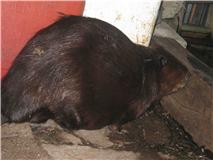
Last year, in the ultimate insult, they tried to set up light housekeeping in my boathouse. I almost stepped on a large male when I was investigating the stench in one corner. It grumbled and waddled off to the water. The next day the smaller female was there but it managed to get to the water before I got to my gun safe. Too bad because they returned this summer. When a 40-year-old guest almost stepped on the big male in the boathouse, Gord confessed "I screamed like a girl." He took the picture of the beaver in the boathouse where it seems to sleep most nights. I guess I now own a version of a Travel Lodge.
One night I awoke to hear a really dumb beaver gnawing just outside my window at a giant poplar that is 19' in circumference. I yelled and it escaped to the water but didn't swim far as if taunting me. I didn't shoot it because I was afraid that if I missed, I would hit a nocturnal fisherman.
Then there was the skunk which tried to live in my garage in the city after digging up the front lawn, the squirrels that gnawed into my roof on two sides of my home to make nests, the raccoons that strew my garbage around if we're careless with lids, the raccoons that not only empty the bird feeders most nights at the cottage but then destroy them, and the porcupine that gnawed my cottage until I shot it.
Just look at how we fail in handling Canada geese. I love looking at a few of them, but not when dozens come up on my cottage lawn to shit on every inch. They're a filthy nuisance in any city park that has water. Margaret Wente of the Globe suggested years ago that we kill flocks and send the meat to food banks. I thought that was a great idea and printed recipes from a native cook book I bought in Midland.
Yet there are regular stories of protests in any city that dares try to reduce the flocks that seem to explode in size when given the slightest opportunity. One costly solution is collect a plane load and fly them into the wilderness. Why don't we just oil the eggs and turn the parents into food?
But there are those mouthy animal supporters - and backers of that dismal, rich PETA organization - who seem to feel guilty for just existing on the planet and say that the animals have been around longer than we have.  Don't eat fish or cows or pigs, and it's just possible an ear of corn has feelings too.
I prefer my "wildlife" to be out in the wilds, thank you very much, and I don't feel guilty one bit for saying I'm superior to them in the pyramid of life.

Friday, July 15, 2011

HYDRO'S CHEATING SMART METERS

HYDRO SCREWS UP AND WE PAY

Once upon a time, Ontario Hydro was one of the provincial sacred cows, touted as the backbone of the  economy, boasted about in international conferences.
Oh sure there were farmers complaining about how much it cost per pole to electrify their farms. And newspapers occasionally ran stories of Hydro cutting off customers through error or handing out exorbitant bills when a meter went wonky.
Ontario Hydro and the municipal utilities that actually fed the electricity to consumers were fat-cat organizations staffed with executives lapping greedily at every last bit of cream in the public saucers. (Fred Gardiner, after whom the expressway is named, retired as the most important municipal politician in Canada but stayed on the Toronto power board because the part-time job gave him a limousine.)
Then came all the generation projects that skyrocketed in cost, particularly in the nuclear field where Hydro boasted about the world's best production until some pipes rusted out. The old question about nuclear power, whether it was safe, was replaced by concerns about whether it was affordable.
In 2011, our  Hydro bills are enormous. The billing envelope is stuffed with pamphlets urging us to scrap our beer fridges and singing the praises of the Smart Meter. They should put in apologies instead.
Ah yes, the Smart Meter! Hydro think they're really smart because it makes so much more money using a meter that has been found to be up to 50% inaccurate in some cities where it was introduced with lavish ad programs. I think the Smart Meters are dumb, dumb, dumb, and even the premier has acknowledged complaints that the Smart Meter can goof when it comes to overcharging during  low periods of use.
I don't really go along with all the Internet worry that the Smart Meter is a health hazard. But I do support those who say it's a menace to our wallet. The stories are endless about how bills have soared even when the users are only doing laundry at 3 a.m. on a holiday Sunday.
The idea is sound, but hardly new. When I bought my house in the 1960s,  Etobicoke Hydro had a electric switch on my fuse board which turned off electricity to my hot-water tank during peak power needs. It was never a problem and I got a reduced rate.
So I understand what Hydro is trying to do, to even out the demand so it can handle the peaks better, but I don't understand my resulting bills which have increased even though Mary has adjusted chores to use electricity most during off hours.
In fact, I think Hydro is cheating me and many Ontario residents and that promising to examine and to end this cheating would be a wonderful issue for the Ontario Tories. The McGuinty government has floundered into pledges to reduce electricity costs but when you add them all up, our Hydro costs go up and up and up.
I have a nice cottage on a point in the Trent River and a modest bunkie beside it which is seldom used. I wrote about the outright thievery of the Hydro bills on both buildings in a blog last Nov. 23 entitled Should Ontario Hydro Be Prosecuted.  As a minimum before a class action suit, either the Ombudsman should take action or the new Conservative government at Queen's Park should appoint a special arbitrator just to deal with the cheating and ineptitude. (One reason the Tories will win this fall's election is because of the McGuinty government failure to deal with the Hydro mess.)
In my blog, I detailed the mistakes that are so obvious, a Hydro chap on the phone floundered into incomprehensibility in a defense.
And it just festers each bill. I have just opened my last from the cottage. For three months - when I was in hospital - there was only 1 kWh used in the main cottage. Yet the bill is $86.88, which I submit is the highest charge in the world for 1 kWh. I used no power at all for the second cottage, the bunkie, but the charge is $75.30.
Up to two years ago, there was no monthly charge for a seasonal building where no electricity was used. That has now been waived in Hydro's drunken insistence on overcharging us. There is a minimum monthly charge of $23.98 even if you don't use the building for years.
Do you think that's fair, I asked a Hydro chap on the phone after my first two attempts to get through went into nothingness? Well, he said, everyone has to pay it. So if you steal from everyone, it's no longer theft but policy, I asked. And he didn't reply. But then, what could he say since he, as a symbolic representative of all Hydro employees, was like a blood-soaked murderer caught standing over  the victim still holding the bloody butcher knife.
Go get'em, Tim Hudak! Electrocute the gouging policies and smarten up the Smart Meters!

Tuesday, July 12, 2011

HOSPITAL HELL (PART FIVE)


LEARNING TO WALK AGAIN.

We take walking for granted. It's just something you do without thinking after those first baby steps.
I started to think about it a lot after six weeks in hospital. I could no longer walk, let alone stand.  When I teetered with two nurses supporting me, I was unable to shuffle for even centimetres. I wondered despairingly just what I was going to do to make my legs work after the muscles had withered.
It was so bad that I asked a nurse once just how long I was going to have weights strapped to my feet. Was it therapy? There are no weights, she said. Which depressed me even more.
 I was in awful limbo. I panted like a dog in August. I had only enough energy to work a converter. (And I often didn't since TV has become the great wasteland it was first called in 1961). Visitors, even my loyal family, exhausted me.
Yet there was improvement. Poisons weren't draining out of me by the pint. (I swear I didn't rip tubes  out, although that was the suspicion.)  I would be on medication for ascites, the accumulation of fluids, for weeks.  My pneumonia would linger, my bum ulcers needed months, and my MRSA hospital infection wasn't about to go away. In short I wasn't an ideal candidate for the next step of rehab.
I didn't sleep much but my dreams were about walking. I pushed to be free of St. Joseph's and placed where my health problems would be dealt with even as I got the legs working.
And so I ended at Runnymede where, ironically, I had been on the board since 1988 and wrote about its struggles to survive, let alone prosper into the lovely new building which replaced the century-old converted school. (I even headed its fund drive, and was terrible at it. )
When I attended the opening and staff Christmas party (and wrote about it last Dec. 14 in a blog titled Great Success Of Runnymede Health Care Centre) I never dreamed I would be a patient for 43 days.
Its past is that of chronic care where patients spend their final days, or even years. But with the new facility, president Connie Dejak wants more patients like me that can outlast problems and return home. The health ministry has just bought into that, announcing $6.27 million in annual operating funds to allow the use of all 200 beds.
A hospital is never going to be a spa, but it helps when most nurses and meals are great. The staff used to boast  just how good the food was. It still is. I was served meals of restaurant quality. Thank heavens! And it all came at a third of the cost of St. Joe's. But OHIP, which paid nothing of my  Runnymede bill, paid 27% of my St. Joe's bill.
Rehab was an ordeal where muscles failed at the simplest tasks with my therapist pushing until my body trembled. Tedious! I never managed more than two steps there without support, but their exercises led me to reclaim that precious gift.
The entire miserable 86 days in four hospitals convinced me that the patient, no matter how sick, and his family, have to pay attention to every pill and every test, or they can become victim. For example, my illness pushed me into diabetes, complete with insulin and the blood sugar vigil. Nurses would forget to bring me the needle and meter. Once I was given a needle filled with insulin quicker and stronger than my routine dose and saved myself.
Runnymede went to great trouble fighting my bum ulcers,  even giving me a bed with a compressor to keep it inflated like a giant air mattress. The first night, I swung my feet out to make my way laboriously to the bathroom. The compressor stopped, the bed edge collapsed, my feet skidded on the slick tile, and I crashed through a table and suspended myself on a TV arm. I couldn't find the call button so after a few seconds, I swore and crashed the rest of the way. They found me face-down on top of a wastepaper basket. It took four to pick me up, put me in that slippery bed and then wake me every hour in the head injury routine. The nurses revolted against the bed.
 I was being taken by a van hired by the hospital to St. Joe's to see an infectious disease specialist. The driver arrived late and needed directions. He tried to drop me and my wheelchair a block from the hospital in the middle of sidewalk construction. I waited two hours past my appointment to see the specialist who spent only a minute with me because the clinic was closing. The driver returned 80 minutes late after I borrowed a cleaner's cell phone to locate him.
He bounded down to the van until I pointed out the wheelchair ramp was steep and slippery from rain. He had to help me brake.  He returned sullenly and I think pushed rather than anchored me. I flew down the ramp bouncing off the concrete walls, grabbing at the rails. I figured desperately I would try to glance off the van fender rather than shoot across the lane into the metal fence that separated it from Queensway traffic. I  stopped just in time after bruising my hands.
He offered no apology as I returned to Runnymede two hours late, wet and shaking.
 I left for home the next day because after that experience that could have broken me, I figured I could handle anything the real world could deal me. Besides, Mary had installed $1,000 worth of railings and grab bars and I had three walkers and two canes.
I walked the length of a room two weeks later, to my outward joy and inner amazement.
I have survived.