Saturday, April 10, 2021

THE DUKE DIDN'T GIVE A DAMN

TREASURING A REBEL

In a world gagged by woke activists where leaders mouth crafted lies instead of telling it the way it really is, the Duke of Edinburg should have been treasured instead of viewed with alarm when occasionally his candour slipped into the questionable.

Like many veteran Canadian journalists I had plenty of opportunities to watch the Royals because of their many visits. Prince Philip had verbal flashes that delighted me although the CBC would have turned them into a crusade of condemnation if its very correct staff had known.

I recall many years ago his love of horses pushing him to a comment that would have had his enemies in the English media drooling. He had been a good polo player and long-time president of the International Equestrian Federation, so naturally I asked about the equestrian events at the Mexico Olympics.

He said he worried about the horses in the high altitude because he was unsure the damn #$@*#* Mexicans cared enough about them. (I heard a similar sentiment later from a prominent Canadian in a box at the Royal Winter Fair who had loaned a horse to the Mexican jumping team which then pretended it had died when it hadn't.)

I never wrote about the Prince savaging Latin colleagues because off-the-record is a rule you never break if you don't want to be frozen into a useless observer.

Once the Duke was visiting the Toronto Press Club, which was a big deal considering his antipathy for the media, and the executive lined up to greet him. He asked what I did and I said I was the membership secretary. "Terrible job," he said. Not really, I replied, why would he say that?

"Don't people want to get their friends in and pressure you? I wanted to join this club in London. They had a ceremony where members voted on whether you could join by each taking a ball and then sticking their hands through a cloth sleeve into a big wooden box. If they didn't want you, they stuck the ball into a ledge up on one side. How would you like to be married to the Queen of England and have two bastards stick a ball there and black ball you."

Prince Philip had a pleasant aloof air in the inspection tours and walk-abouts, an attitude of confident approachability. I recall staying with a Toronto group with some clout in a guest house in Beijing that the Chinese reserved for important visitors. I was poking around and found a staff member who spoke English and boasted about how the Queen and Duke had stayed there. She raved about how great they had been, especially the Prince.

Remember the nice story that Allan Dickie wrote for CP about how the Royal couple had made everyone so relaxed at a luncheon in Yellowknife that as the meal ended, a big motherly waitress tapped the Duke on the shoulder and said "keep your fork, Duke, there's pie.)

Of course the graceful Queen is the mistress of comfort. I once blundered as a kid reporter into a little group of welcoming dignitaries beside the royal yacht Britannia. She spotted my press credentials and smoothly passed by with a smile.

At the start of Royal tours, there is often a session where media brass are invited to chat with the Royals a day before their staffs are set loose upon them. So there we are in the Ontario Room of the Royal York Hotel, the various editors and publishers herded into little groups. The Queen and Duke split up and circulated. I surveyed my group and worried it would be awkward because everyone would be too awed to chat with the Queen. So when she joined us, I started talking about how long a day it had been for her because she had flown just that day. She said she always kept her watch on London time as one way to combat jet lag.

She was there for the Queen's Plate and since she is famous for her knowledge of racing and blood lines. we talked about her presentation there. "Did she bet," I asked? She said she gave wagers to a lady-in-waiting. I said there was a long shot in the Plate that some had written was an interesting gamble. She nodded, smiled again, and went on to the next group.

The horse ran last  ...  dead last.


Wednesday, April 7, 2021

ONLY THE IGNORANT WOULD RENAME RYERSON

 AN APT NAME AND A GREAT STATUE

A mouthy minority of activists in love with indigenous posturing has been blathering for several years about renaming Ryerson University and demolishing the statue on Gould of the great educator after which it was named. 

We know that those who don't know history are condemned to repeat it but in this case those trying to scrub the past have  no clue as to what went on.

They say Egerton Ryerson was responsible for the odious residential schools that were a blight on native families as callous bureaucrats snatched away their kids. But there are problems blaming Ryerson as the major figure in the dismal operation of indigenous residential schools since he was the creator and boss of the ONTARIO school system until 1876 and died in 1882 just as the FEDS began them.

If the no-nothings actually cared about facts rather than a fictional nonsensical cause they would have had to search verbal mountains for proof. After all Ryerson was a prodigious writer. An endless flow of words in letters, reports, sermons, speeches and even a lengthy biography poured out and as a proud stubborn Methodist there was no mistaking his meaning. But in a real life of real facts critics would find nothing but respect and even love for the Mississaugas as he worked around the Credit as a missionary.

In his monumental report and speeches of the mid-1840s that built the school system of Upper Canada and then the entire country as it was born, Ryerson did recommend residential schools for what everyone called Indians because he felt they needed lessons in agriculture instead of relying on hunting and fishing. 

Yet his main thrust was for free education for all, not just schools for the more prosperous families, and for Normal schools for budding teachers, the first public museum, textbook publisher, and art gallery. His role when some chiefs and officials wanted to start two indigenous schools was as the expert adviser to produce a curriculum to help if Indians were to settle and not roam. Those schools failed because the government didn't help enough but were better than what the feds later forced without Ryerson's tolerance for minorities and other religions.

When the first assaults on the Ryerson name began because supposedly he had been integral to the shameful residential schools, I was perplexed. Where in heck did that come from? A great PROVINCIAL educator was blamed for a FEDERAL operation that festered AFTER he died.

I also worried about what I might have missed when I ransacked the archives of the university, city and province for my book Ryerson University - A Unicorn Among Horses. I read a wealth of his writings, even the original letters he sent home from his many inspection trips to England and Europe. I read yellowed newspaper clippings about his death as a "great" Canadian, and how there had been a subscription where the government and pupils from as far away as the New England States had contributed $8,000 for his statue. (Even politicians gave their dollar.) 

Almost nothing in all that about residential schools.

I read his entry in The Canadian Encyclopedia and books of admiration by historians, one of whom wrote Ryerson's first head, H.H. Kerr, to say that he could not imagine a more suitable name for a university than Ryerson's.  Nothing about indigenous residential schools.

So when I wrote about him and how what he left behind grew into a university, I mentioned residential schools in only one sentence. 

Not that I hated the idea of residential schools, not when I grew up reading about legendary Eton and Harrow. Then there was the Ontario equivalents like prestigious Upper Canada College, and the fictional ones like Hogwarts. After I was orphaned, I was almost shipped off to Ridley.

In all my experiences at Ryerson, I never heard a peep that the international giant was a racist who considered the indigenous to be inferior. I have a certificate, diploma and degree from Ryerson. I was student president and editor of the campus newspaper. I lectured there, and served on board of governors committees and task forces doing everything from searching for a new president and journalism chair, revising the Ryerson act, overhauling the photography courses, advising the journalism department and writing the history plaques.

Never a word against the great Canadian!

This anti-name campaign resembles a stunt by drunken freshmen in an academic pub to replace the historic name on a school that was supposed to be different. Of course the university now wallows in correctness, with education pushed to one side, if there is time left over from flagellation, and the symbol of a statue almost 10 feet high on a granite base of similar size, one of the better and more meaningful statues of the city, is to be cast aside into a swamp of indifference and ignorance.

Two Ryerson profs, Ron Stagg and Patrick Dutil, in a fine piece in the National Post on April 6, detail the indigenous history of the church leader. How the tribe so honoured him they made him a chief,  and how he had as a lifelong friend a chief known in English as Peter Jones. He even made a secret appeal to Queen Victoria when the Mississaugas had land confiscated by bureaucrats.  (Such was the power and clout of Ryerson that he started a college named after Victoria which of course became part of U of T, the best university in the country according to my three sons and me who all went there.)

The Ryerson academics concluded their Post article, which is filled with facts, unlike those making silly accusations, with this appeal. I would urge that Ryerson grads listen because it is time they rebel at the waves of nonsense coming out of the university and the committees considering the name dump.

They finished: "Torontonians today must recognize that Egerton Ryerson has been falsely accused and restore their pride in celebrating one of the best minds of their past."

The critics should at the very least be sentenced to scrubbing his statue with toothbrushes, as we once did with frosh. But that might hurt their feelings, and heavens we never ever should do that, especially in the modern classroom as universities wilt from actually teaching.


Friday, April 2, 2021

THE SUN ALSO RISES

 THE WEEK THAT WAS


We didn't want to mar the final edition of  The Toronto Telegram. After all the glories, innovations and goofs of the newspaper since it began in 1876, we wanted it to enter history as error free as possible in journalism.

So the disintegrating Tely family nitpicked and agonized through the night on October 30, 1971, while nursing headaches of doubts and hopes. It had been a long funeral since John Bassett kept it alive for weeks after he announced the murder because of a Tory leadership convention.

I settled gloomily at the news desk as the first edition flopped in front of me. "THIS IS IT" was the headline, and a big 30, the traditional way for journalists to write the end.
As the Assistant Managing Editor I was lowering the paper into the grave. The only bounce around me was in people not worried about what came next. Such as Clyde Gilmour who telephoned insisting I read his review to him so he could check for mistakes. But then he would start Monday at the Star as one of Canada's leading movie critics who also had a radio show for his records.

The copy boy who scooped the first copies from the Star presses arrived and the daily search of comparisons began. Ray Biggart running the city desk wondered about what we didn't have, mainly the big headline about another pronouncement by Walter Gordon, the Grit guru the Star idolized.

Did we want to scalp the story, the daily copycat exercise as the two giants compared editions?

It didn't task my judgment. The Tely would go into oblivion ignoring the Star's pet. Even though Gordon had a farm outside Schomberg and allowed his neighbour, my brother-in-law Gordon Long, to run a trapline. As the famous economic nationalist, he loved the idea that beaver were trapped there, an echo of the fur business that started the country.

 But then there was the time as a young reporter, also working on the census to get enough money to get married, that I asked his wife in their lovely Rosedale home whether the future federal treasurer from the prestigious accounting firm made more annually than the top census figure of $35,000. She said she certainly hoped so. In 1961, that was seven times more than I made. 

Biggart didn't argue. He was looking forward to being City Editor on Monday of a different kind of  newspaper that was being born out of the mess, the Toronto Sun tabloid.  Like many of the 62 Sun "day oners" he went on to an illustrious career as the influential assistant to Paul Godfey, the rookie Metro chairman, (after I turned the job down) and then as Metro parks and property commissioner.

Nothing much happened that day. So I gradually let the staff trickle away. I went into the sound-proofed room, basically a large closet, that housed the many teletype machines that tethered the Tely to the wire services and the world of news and checked for one last time for crashes, sinking and revolts. Nothing! So I turned them off, one by one by one.

Then I went to the composing room and told everyone to go to the wakes. I stood by the "turtle" that held the front page form and ripped up the Telegram name, the metal flag at the top. A sad trophy for my study wall, along with the matte from which the front page was made.

From there to the thunder of the press room.  How were they running? The foreman cursed and said the damn things had never run better.  I asked what the run call was from circulation and advertising. He said for 328,000 copies. I said people were stopping the delivery trucks and offering dollars for the final copy. How about if we run the presses out of paper? They can't fire both of us because we're ALL gone. Besides he had a job Monday with the Star. So he shrugged, turned the counters off and ran perhaps 345,000 copies before the newsprint storage room was empty.

I returned to an empty newsroom. Alone in silence. I made a sad circuit of all the empty desks and offices, grabbed the big wheel of contact phone numbers from the rewrite desk and carried it and the front-page metal by a startled security guard to a vacant parking lot. 

It was a Saturday of anxious farewells for 1,200 Tely employees, many of whom never worked for a newspaper again. But for the 62 gamblers, there was anxious hope up a rickety elevator to the fourth floor of an old building and rudimentary quarters spotted with equipment left behind by a bankrupt company.

I didn't sleep or party. On Sunday I felt like I had the flu as I sat at home at my portable typewriter picking at my first Sun column on the dangers of spending a lot on a new stadium. It didn't help that John Henry and Brett were oblivious and rambunctious and my third son, Mark, was demonstrating that three-month-old babies can be cranky. 

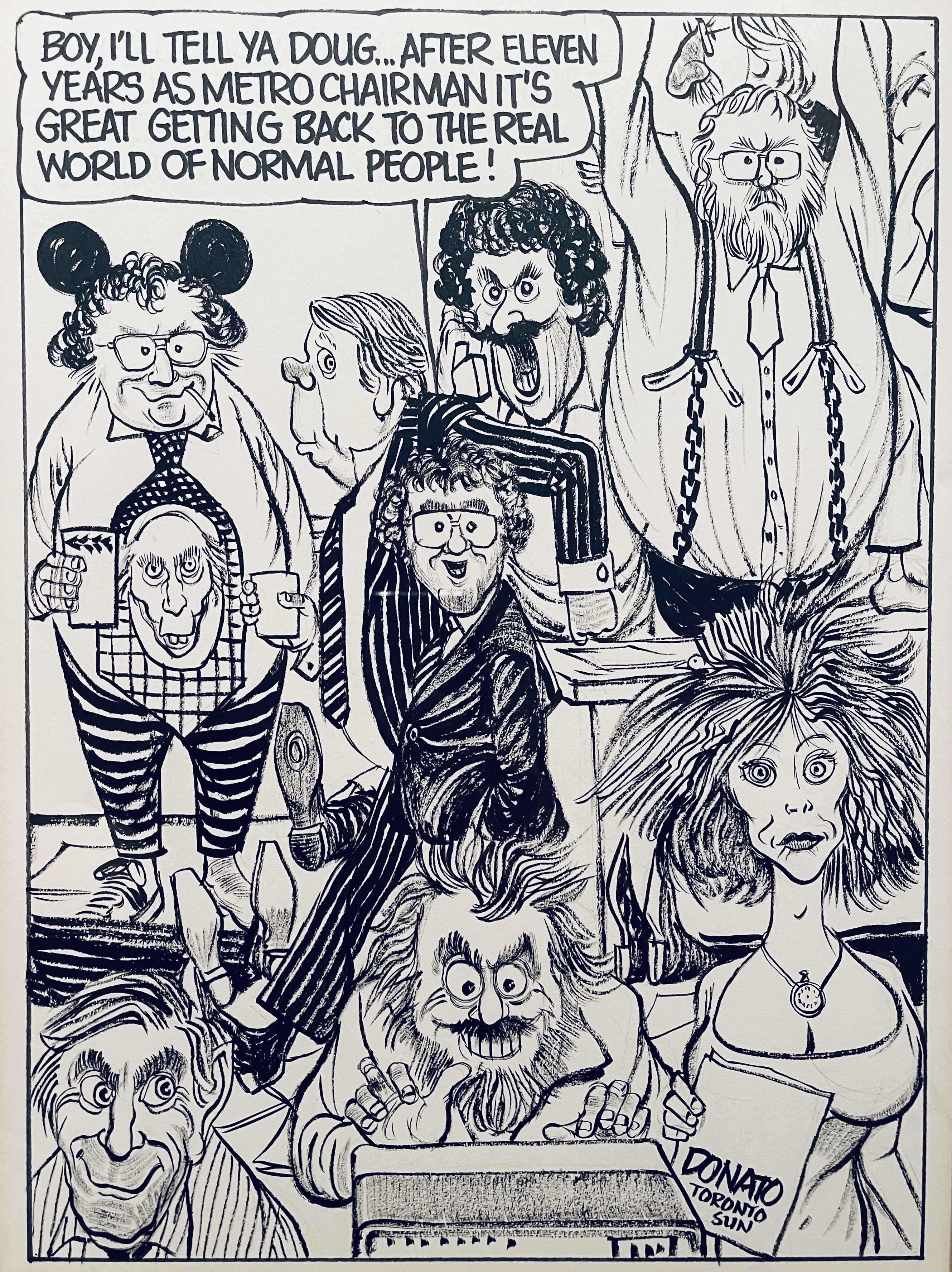
Had I chosen wisely for my family when Doug Creighton offered a daily column as the only one covering politics in a small paper? The Star had turned me down when Borden Spears said hiring me would upset their newsroom structure. The Globe hadn't replied. And I had turned down more secure but also probably more boring jobs with the federal fisheries ministry, Toronto Harbour Commission and Etobicoke school board to wade into the unknown.

Creighton greeted me cheerily as I arrived at the strange new home in the afternoon and when I confessed to my Tely mentor about my worries swept me off for lunch in typical style to the Walker House. Nothing like fine food and a few drinks with an old friend to try to make me think this may work out. So I had my first of many grand meals before I even set foot in the Sun, In the future many would say the same as Doug built the paper with his charm. 

The "day oners" worked too hard to pay attention to that All Hallow's eve and the trick-or-treaters roaming  the dark. There were no resources but experience. But then Monday morning dawned with the sale of all 60,000 copies - except for souvenirs squirreled by "day oners"- leading to the glimmer of success.

I arrived at City Hall to find the Globe had taken over the better Tely office overlooking the Archer sculpture and city property commissioner Harry Rogers (father of Bruce of radio fame) had no intention of giving city space to some unknown little newspaper even if he did know me.

So I descended on Mayor Bill Dennison who had known me since he had started as a trustee when my father, an east-end doctor, had been chairman of the Toronto school board. And Denison ordered Rogers to give me the Globe's old office.

I checked with the office to find that Don Hunt, the third member of the founding triumvirate who looked after promotion, had arranged the first contest. He had hired Bert Petlock, a former Tely police reporter before the PR world, to get a client to donate a big net, tanks of gas and balloons. The idea was to launch the balloons from Nathan Phillips Square. One would have a slip inside awarding an exotic trip from some company that had been conned by Hunt and Creighton into an exchange for future ads. 

I found Petlock and limp balloons but no ceremony. So I went back inside and persuaded the mayor to officiate. Petlock inflated the balloons watched carefully by a growing circle of urchins on their battered bikes. The mayor muttered a few words prompted by me. There was no one else there. The mayor tugged the net off but the balloons just rolled around and didn't fly. A few boys didn't wait but rushed in, grabbed a balloon off the ground, and hightailed it for the Sun. No one seemed to know how they knew about the contest or the Sun's strange new address.

I phoned Hunt and we decided to ignore the first boys on the grounds they had cheated. I left him to sort the rest out and walked up University to the Legislature, the first of many such trips since at the start there was no one else covering politics.

Of course the old Tely office there had been captured before I got there. I sat at the big table that dominated the press gallery and appealed to the reporters having the first drink of the day. Since a few sat on the executive of the Toronto Men's Press Club, and I was the future president, I managed to extract a promise of some form of space and a seat in the press galley perched over the Speaker's dais.

It was a hectic day. I walked back to City Hall and managed to stay long enough at a transportation committee meeting to cobble enough for my second column.

The Sun office was organized confusion when I arrived searching for a desk and a typewriter. By the second day Paul Rimstead and I worked out a deal by which we shared an old typewriter and battered desk shoved up against some mysterious and dirty machine. It seemed a suitable arrangement since my column ran across the bottom of Page 4 and he was across the way.

Both Paul and I ached to escape the confusion. He was clutching a package of six assorted mickey-sized liqueurs delivered by one of his many fans and offered me the cherry one if he could write first. He wrote his first take. Then he drank the Creme de menthe while I wrote the start of my column. Then we switched. He composed a second page while I drank. Then we switched. Much was consumed by the time we finished and decided heartily that the Sun may well prosper even if it was in the old Eclipse building. I went to work the next day to find out how my column ended. 

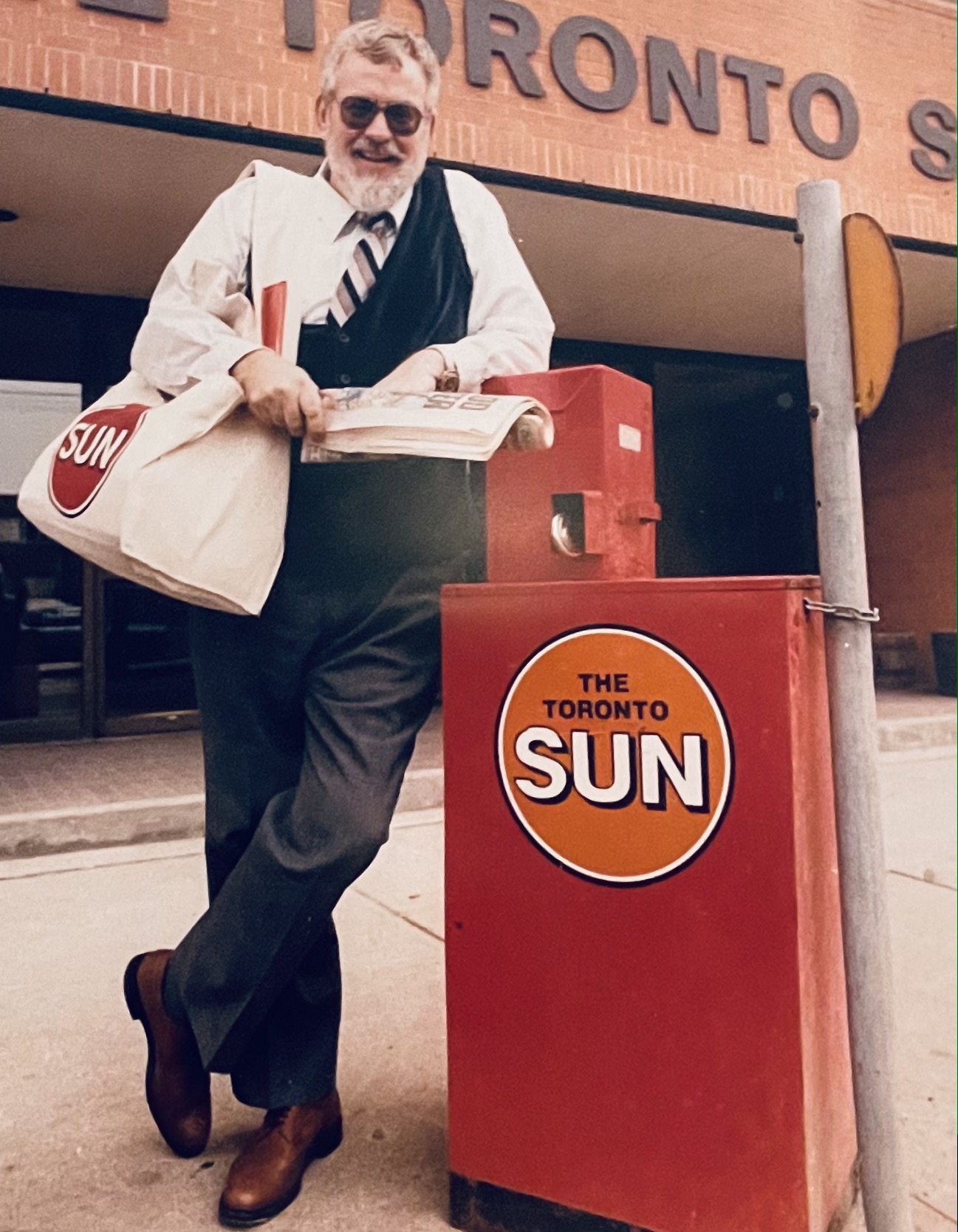
And so the Sun began for my 40 years there while 60,000 newspapers grew to more than 300,000 daily and 500,000 on Sunday. We deserved that too since we pioneered Sunday newspapers for the country. Then the little paper that grew shrank along with the entire news trade. My life downtown, my 50 years in journalism, have become memories without structure since the two Tely homes have vanished, and the Sun has moved from the building designed by John Parkin, the architect who worked on City Hall. 

And I went from a cub that a prime minister wanted fired to a PM phoning to congratulate me on becoming Editor. Decades of typing and perspiration and inspiration for 6,000 columns and 3,000 editorials. The highs of being quoted even in the House of Lords at Westminster to the lows of libel suits. The peaks of chatting with Netanyahu, arguing with Fidel, lunching with Mandela, and kidding Clinton to the goofs like forgetting the name of the politician I was interviewing on TV.

The Sun's golden anniversary this fall celebrates 50 years even as newspapers die by the thousands. But not my memories!




Friday, January 1, 2021

JOAN SUTTON'S GRAND APPETITE FOR LIVING

There Is Nothing Like A Dame

 The announcement that Joan Sutton Straus is one of 22 receiving the Order of Ontario said she was "one of Canada's best known journalists." She almost wasn't, but she would have been "best known" in her beloved country no matter what she did in a life overflowing with love and ideas stirred with passion and insight.
Once upon a time, she was fed up with the pressures of the fashion world and contemplated a change that would allow her to use her special knowledge of that and high society in her city. So she applied to the Tely who needed a fashion writer.
As the Sixties ended, it was a rowdy time in the newspaper wars where the holy Star and the far-more readable Telegram slugged it out edition by edition. But the Tely kept slipping. So John Bassett, the arrogant man-about-town who ran the Tely for his three sons and the four Eaton department store boys,  turned his paper over to Doug Creighton.
Creighton ended up using charm and an intimate knowledge of the city and his paper acquired as a police reporter and editor to centralize control of the second largest paper in the country. He ran everything with two deputies, Ed Monteith as the assistant managing editor running news and the Monday-to Friday editions, and me as the AME running everything else and the larger Saturday paper.
For me, I was thrown into a world filled with famous and credentialed people often twice my age with thin skins and decades more experience. My mistakes often appeared before hundreds of thousands of readers.
My search for a new fashion writer was a mine field since the Lifestyle (women's) department was populated with the kind of women who didn't even look at you when you asked them for a dance.
So I arrived for what I thought was just another interview at a famous Italian restaurant frequented by Queen's Park insiders, The fare was great yet so was my trepidation as I thought of the resting sharks back in the newsroom because this was turning into a make-or-shatter-me hiring. But Joan Sutton was great as she outlined a background richer than I anticipated. I returned to the office with no doubt that this hurdle had been cleared.
Creighton greeted me with happy news. He had hired me a writer. I spluttered that I had a new writer starting in a week. Creighton and his supposed boss Arnold Agnew (who was married into the Eaton family) told me that was impossible. The woman they had hired was one of the best friends of Doug Bassett's wife, one of the owners. 
A miserable afternoon followed with me arguing sporadically that I had given my word  to Joan Sutton and her career had included such positives as "dressing" performers for CFTO, which was Bassett/Tely owned. I refused to cancel my job offer. I ended up telephoning Mary to say that my success after only 10 years out of university had just crashed and burned over an Italian lunch. 
By some miracle, Creighton and Agnew finally conceded. Any joy I felt was tempered by a phone call from Doug Bassett demanding whether I knew when I hired this Sutton that the person promised the job was his wife's best friend.
I said I did, figuring I might as well go down with all guns blazing. There was a long pause, and Bassett sighed that I would get away with it "this time."
For some reason. I was running the City Desk when Joan came in on the Sunday night before she started work and gave me her first feature, about the great difficulty women had because clothing sizes were not uniform. You had to know that this company's sizes were all larger than that company's sizes.
I read it through with Joan waiting anxiously. I said it was fine. Indeed we used it as a spread three days later. 
So I should have known right then Joan Sutton Straus was going to become one of Canada's best-known journalists because she was so driven to excellence that she wrote her first printed article before she even was on the payroll.
Ironically, considering her hiring, Creighton finally made her a key insider and she was one of the 62 known as Day Oners who started the Sun when the Bassetts finally sold the Tely out from underneath us. 
An account of Joan's life would be a good book (maybe even a bodice ripper) because she has been a beauty queen finalist, model, columnist and government insider. She knew all about the city and province and the secrets of famous people were familiar to her. She organized an intimate memorial service in a Beth Tzedec chapel one afternoon and I sat with a former veteran premier and flamboyant attorney general listening to an eulogy from one of our most famous diplomats.
This honour is just another recognition for a grand lady who has had a great life. The tales she could still tell.


Saturday, May 16, 2020

DAVID PRESCOTT DID EVERYTHING WELL


RENAISSANCE MAN IS AN APT DESCRIPTION

On a recent Sunday, sons Michael and Neil rented an ambulance and took their frail father to sit beside lock 25 on the Otonabee where he had fished so often. David sipped his favourite drink, an extra dry martini - to hell with all the medication - gazed with contentment over the river that flows through the heart of Peterborough, and tried to forget the hospital where his wife had died weeks before in the room they shared.
And then he returned from his last birthday party to that hospital to die a few days later. Fortunately Michael and Neil were with him, thanks to some compassionate nurses.
The pandemic robs us all of peaceful passings when even loved ones can't visit or are hampered at the end by the emergency rules, when David was blocked from moving to gentler surroundings by a decree announced even as the transfer stretcher was in the hall.
I wrote in blog.johndowning.ca when his Margaret died, the gentle matriarch of Plewesville, about how families at such artificial times, when virtual reality services of knots of mourners strain to replace funerals, when we deal with doctors by email and telephone and hope and frustration, that we all must share the love woven through our nostalgia.
When the world stumbles along this path to the unknown, we must spend more time savouring the past before the shroud drops on the future.
There is much to discuss about men like David Prescott who did everything so well that those around him, whether at CIBC or the golf club, recognized his graceful skill. So he would be bank manager and then assistant general manager for the country, or a steward ready to defend the rules during the Canadian Open.
You and I might decide to catch carp one morning but David had the special rods and knowledge and knew about web sites and shops that dealt only with carp. No trout or pickerel was safe when David scanned the water with an expert's eye.
He loved wood turning and became so good that he gave his bowls as gifts (thank heavens) and sold them at shows and became president of the Peterborough wood turners. He drove hours to buy special woods, but was great at scavenging. We were driving a country road and he shouted stop. He went to the farmhouse and asked if he could have the twisted stump he had spotted in a woodpile. The surprised response was yes.
I could barely see the woodpile, let alone the lovely gnarled knot, but he had a keen hunter's eye. He would identify the hawk swooping above the point when I could only see a dot, but he loved to label birds and fish and trees and wild flowers and when I challenged him with a guide book, he was right.
He had an affair with Mother Nature because he understood her right down to the roots.
The list is endless of what he enjoyed doing. And he was good at it, from bluffing with two deuces to dropping the fly just behind the rock where the trout had hunkered against the current.
 Most of us are content in retirement to take it easy many evenings, but David was always on the go, from theatre to lacrosse to all music, especially opera and choirs, so of course he was a leader in the choral activities of his adopted city.
He was willing to play cards until the cows came up for milking. He would search endlessly in the markets for the right tomato or sausage. He would ....but let's just leave it at that. Name some activity, whether urban culture or hunting, and David had done it with finesse and passion.
He was a man to be envied because he had come from a humble background and education to milk the joy out of life and then to sip it like that extra dry martini that Sunday afternoon with his beloved boys around him.


Sunday, May 3, 2020

MEMORIES OF PLEWESVILLE


TREASURE THE FAMILY STORIES

And so another of the family dies without dear ones close.
It is a time then to treasure the past, to remember the joys and gaffes of growing up and flying away from the urban nest that was Weston before it was ruined by progress.
A time to cling to tidbits of nostalgia to comfort us in the sterile artificiality of a virtual world that tries to substitute even for our funerals.
In the day when Hollywood was still golden, there were popular movies like Cheaper By The Dozen that cast a romantic humour over large families. Magazines like Reader's Digest dominated the media. It loved big families and boasted a regular feature on the most unforgettable character the writer had ever met.
I think often these days of the decades after the second world war to end all wars because more of those familiar faces around the big table at mealtime long ago are gone now or cloaked with age.
Plewesville is located in dozens of memories and was a modest home on Weston Rd. in the south of what was a pleasant old mill town.
It used to burst with people. There were Aunt Jennie and Uncle Dave, my guardians after my grandmother decided an orphan boy was too much trouble. And my uncle's mother (and perhaps for a time her boyfriend.) And 11 Plewes children.
Then came the additions and subtractions of life.
The oldest girl, Verna, died in a car crash from the head injuries when she bent over to protect the baby on her lap. So the family adopted Margy because the father was a scoundrel.
Then I came along from Chesley, the sleepy furniture factory town of 1,800 near Owen Sound, to the city just stretching its muscles.
It was not that big of a house. Four of us lived in the attic which may not have had height but at least there were stairs. There was only one bathroom but the tub was in the basement. We managed because no one tarried. Once when Margaret did with some chums, Uncle Dave quietly removed the bathroom door to teach her a lesson and looked in with horror at strange girls.
Margaret just died after a long fight. Because of the pandemic we haven't been able to gather and remember stories like that about the warm lady who became the matriarch.
And now Robert with his wry smile has gone too, suddenly, without even a corporal's guard.  And I wonder if his sons know about the Saturday night we were playing hide-go-seek at twilight and he found the perfect hideyhole behind the water heater. Unfortunately he stuck there and then started to scorch and we were trying to dismantle the heater when we pulled him out, removing some skin.
It was only possible because it was one of those rare occasions when Aunt Jennie had fled for some peace.
On another occasion when the fiery and wiry lady who dominated the home was away, Paul who sat on my left for meals got into a heated argument with Dave who sat on my right and they started wrestling. When Paul decided to stab Dave with a table knife, I appealed to Bill to help me break it up and Bill refused, observing that it looked like a very dull knife.
Bill has been dead for years. The charismatic imp who was the student president at Weston Collegiate and art college who tapped the phone to listen to sisters talk to their boyfriends and squeezed .22 bullets in a vise just to watch them ricochet off the walls.
Oh yes, there was an element of danger running through the agreeable chaos of Plewesville. And innovation too because Uncle Dave was a brilliant engineer who designed unique machines and the boys learned his ingenuity when they weren't crashing on ramps in the driveway.
Uncle Dave had grown in London where the Lombardo family lived just behind. Chicken thieves, he called them, even after Guy became one of the most famous band leaders in the world and employed his brothers, one of whom had a crooked nose that my uncle had broken.
Uncle Dave acted every day like he was auditioning for that unforgettable Digest section. He broke every rule of family, society and indeed life as he drank too much and flummoxed his family by starting construction on bits of the house and never finishing. He bought food and milk by the case and had to bargain to do it because stores were baffled by his demands.
We figured his oldest son, naturally named after him, would follow him to the engineering firm he ran in what is now Liberty Village but David rebelled at the natural fit despite his talent around machines.
David died a few years ago, so we no longer remember when he, Bill and I owned a 1930 Model A Ford. Like the evening we put a set of rear end gears in the wrong way and ended up with three speeds in reverse. So we drove it late at night in the summer quiet of Weston Rd. to see how fast we could go in reverse.
The annual family picnic will be missing more faces when we are finally allowed to have one in a Lindsay park. It has been shrinking from a hundred or so as many of us have passed the Biblical promise of three score years and ten.
With Margaret and Bob, there are now five deaths from the core, since Margy died a few years ago in the Maritimes where she worked teaching deaf/blind children. They made a movie when Helen Keller did it but Margy laboured for decades in anonymity except for grateful parents.
Big families aren't fashionable now, and some of my cousins, who are like brothers and sisters, remember when they dared to gossip about us in Weston (but not to our face.)
Before the huge advances in medicine that ended childbirth and childhood being more of a gauntlet to  endure than a celebration of life, it was common to have big families. You needed spares.
Like when this family began in 1899 when a 22-year-old distillers' hand, Willem Hoogstad, married 23-year-old Cornelia Creteer, daughter of a distillers' hand, in a suburb of Rotterdam.
Grandpa got religion and decided booze was not God's way. No work for him then. So the Salvation Army helped him come to Canada in 1905. There were nine daughters, four of whom died.
There were tough years in Chesley, but the five survivors learned to endure even as passions ran deep.  Four of them put the youngest, who always tattled, upside down in a full rain barrel and she only survived drowning because my grandfather accidentally discovered her. One became a missionary in Nigeria, my mother married a doctor more than twice her age, and Jennie and the other two went on to have large families that spawned farmers, teachers, ministers and nurses.
The girls didn't talk that often in their final years after an exhausting life. No gabbing across the distances between Weston, East York and Chesley. There is a lesson there for all of us as we try to ride out a pandemic, to escape an ending where we slip away in isolation, and our anecdotes, our "remember whens," fall to silent linoleum because there is no one there that has the time to listen.
Don't let the warm times, the magic moments, the embarrassments, dribble into black holes when you still have the opportunity to chat with friends and folks about the family tales of yesteryear.


Friday, April 10, 2020

BOB WEBBER'S VIMY RIDGE


HOW THOMAS RICHARD HENRY SAW IT

Every anniversary of the bloody birth of our nation in the horrors of Vimy Ridge, Bob Webber sat at the battered Underwood in the ancient building known as the Old Lady of Melinda Street and wrote in his sparse style about life in the trenches there from April 9 to April 12, 1917.
He survived as a sapper, sort of a battlefield engineer dealing with everything from the construction  of bridges to the menace of mines, and started at the Evening Telegram in a precarious probationary position covering the sleepy suburbs.
His boss had been in the same war but far above as a flying ace.  Bert Wemp never got around to telling Webber the job was his permanently because the major was busy doing politics on the side, finally becoming the Toronto mayor.
Eventually Webber became financial page editor and started a column that strayed from business news into chatty observations on life around him. The editors tried different titles but it was decided that since Webber was "Everyman" in his views, what could be more natural than name it "How Thomas Richard Henry Sees It" and move it to the editorial page.
When I started as a kid reporter near the end of his 42 years at the beloved Tely, it had to be explained that TRH was really Bob Webber and that the name derived from a expression common in the day about every Tom Dick and Harry.
The newsroom was filled with legendary journalists who had survived World War Two and the battles against the Star which often seemed as tense. Such as Phyllis Griffths, who was in the first Sports Hall of Fame as a championship basketball player, sports columnist starting in 1928, and a woman who pioneered in jobs once done by men.
Griffiths and the stalwarts loved the quiet but genial TRH who otherwise would have been eclipsed by their formidable presence. She called him a "gentleman" whether you used one or two words.
TRH didn't give you a column on one subject or a strident lecture but gentle views in paragraphs. Often readers sent in donations telling him to pick the charity. He raised $2,000, then a huge sum, for a farmer who had lost a foot rescuing a child from a buzz saw. Later she wrote that she had bought a foot and would it be OK if she spent the rest on some cows.
As an awed rookie, I didn't know quite what to make of his chatty items but found later that readers loved it when you gave them several commentaries in one column and didn't always blow fire.
This was back long before you could compose a newspaper on computers and columns pontificated for an eternity. TRH thrived when scissors and copy spikes and pots of glue cluttered the big curved copy desk and fleshy profane men wearing eye shades and cynicism hacked at newspapers and copy paper before stories were sent down pneumatic tubes from the fourth floor to the hot metal world of the typesetters.
One day TRH decided he needed new scissors to deal with the pile of clippings and notes from which he built his column. He probably bought the scissors himself, since the editor who presided over such things often demanded to see the stub before he gave you a new pencil.
And then, because shiny scissors would disappear within seconds from your desk, he went to the engraving room and etched his name with acid on scissors which sit beside me as I write this.
I have no idea how I acquired them since the Old Lady vanished under Bay St. redevelopment in the 1960s and its replacement is gone too after being used by the Globe. But any veteran journalist  accumulates and I have done my share. (I still have unused Telegram envelopes and it died in 1971.)
They're eight inches long (20 cm) with just a few flecks of the black paint that disappeared decades ago. One tip is broken. They tend to mangle rather than cut but I really don't give a damn because it is my humble link back to a vanished time in journalism and to one of the great battles in our history.
It was, as any Canadian should know, the first time the Canadians fought as one army. The four divisions came together of the Canadian Expeditionary Force, all 100,000 Canadians from cities and towns like the Paris where Bob Webber decided to go to war rather than school one morning back in 1915.
All the dictatorships of superior British officers bossing around the colonials were swept aside and Canada emerged with the respect of  the mother countries and also the world.
Just battered scissors, hardly a golden torch to be held high, whether we are talking about the immortal words of In Flanders Fields, or a gentle man who for decades remembered folksy anecdotes for newspaper readers of what daily life was like those terrible days on Vimy Ridge when a country bled its way into military fame.
On those four days on a muddy hill in France, 3,598 Canadians died and 7,000 were wounded. Yet our country fought united. Something to cherish as we pull apart a century later!