Wednesday, November 9, 2011

TORONTO TRAFFIC VIGNETTES


    DO TRAFFIC COPS EVER HELP TRAFFIC?

It's 10 a.m. just west of University on Adelaide. Illegal parking has congealed both sides of the street.
A cop, probably paid duty, stands nonchalantly on a corner ignoring everything and everyone except his cell phone. Several bulky construction trucks block everything. Two workers argue. No work is being done.
Then a cyclists zips the wrong-way on the one-way street of Simcoe through a red light. No one pays any attention, certainly not the cop.
Just another weekday morning downtown.

                                                           .............................

On a weekday morning, the outside lane of University just north of Adelaide is blocked with City of Toronto vehicles. Parks employees are grooming the orphan parkland in the middle of the avenue. An hour later, they move to the other side of the strip of grass and flowers and block the other side.
And a journalist wonders why they can't do that early or late or on weekends. After all, I've worked newspaper shifts starting at 6 a.m. and 6 p.m., midnight and 2 p.m.  Why can't our municipal employees also work similar shifts so they don't block major roads when traffic is heavy?
Or do they have to act like librarians staffing our libraries during most of the hours when most people can't use them?
Remember when banking hours were only from 10 a.m. to 3 p.m. If stuffy bankers can change, why can't all those public workers who supposedly serve taxpayer? Or doesn't that fit with time-clock mentality and fat pay for easy work?
                                                          ......................

The first opportunity for drivers to drive between Park Lawn and Prince Edward to Royal York as they head north from The Queensway is Glenroy Ave.  For 20 blocks they can't cross Mimico Creek because some objected to a bridge decades ago. So the rest of us in Etobicoke have been sentenced for an eternity to a crippled traffic flow.
So Glenroy, which is only four blocks long, is a very busy street. It was used by emergency vehicles and buses and hundreds of vehicles, and of course all the illegal parking by parents dropping off their kids at the junior school on the street.
Now there are speed humps between the new stoplight at one end and the deliberate narrowing at the other. If you need a firetruck or ambulance when seconds really count, you won't get any quick help along Glenroy because emergency vehicles won't use streets with speed humps.
And the throat constriction makes it difficult for cars to get in or out, and just one truck can plug it dangerously as cars try to squeeze by.
 I know. I have lived one house away from Glenroy for nearly 50 years.  I know that the traffic that doesn't want to face the road hassles use the first through street to the north, Edgemore, and use it with such vigour that few stop at the one stop sign and many barely hesitate at an irregular dangerous corner.
All this comes with no thanks to politicians and traffic engineers who don't live there. And residents of a dozen or so houses on Berry as it ended in a dead-end street. So thousands of people daily are inconvenienced by NIMBYism running wild,  and councillors who don't give a damn.
Toronto is nearly 250 square miles, dotted with similar problems left behind by selfish neighbours and gutless politicians.

                                                 .......................

And we wonder why our traffic is a mess.
Perhaps if a few more cops actually helped traffic instead of manning cash-register speed traps, it would be better. Actually when I see a speed trap in the usual cunning locations, I wonder why the cops instead of punishing us don't hand out medals to anyone who actually manages to get close to the speed limit on a major Toronto street.

Tuesday, November 8, 2011

DUMB BOAST BY MACLEAN'S


INTERVIEWS ARE EXCLUSIVE FOR FOUR SECONDS

One of the silliest bullshit stunts by media come in the preening boasts about "exclusive" interviews with prominent figures.
You know, the editor knows the personality or leader was interviewed at 1 p.m. and 3 p.m. but bigawd my guy had an "exclusive" interview at 2 p.m.
Walter Isaacson has been the main editor at Time and an accomplished biographer. After his book on Steve Jobs was released, Isaacson has appeared on or in just about every media outlet known to man. In fact, it would be easier to list the media that haven't featured him.
So I found it amateurish nonsense in the Nov. 14 Maclean's in the column marked "from the editors" for one of them to write that Isaacson had talked to their correspondent "in an exclusive Canadian interview."
An "exclusive" interview is something to crow about if it is with someone who hasn't been talked to for years and has something to reveal. That happens rarely in in the relentless 24/7 news cycle where you can be bored within a day with the coverage of the death of some person you didn't even know had been alive.
Any media boss that wants to hang an "exclusive" tag on a talk with a PM or CEO who is quoted widely and regularly should be forced to take a Journalism 101 course.
Now I have had my share of "exclusive" interviews and scoops but I became so weary of such breathless claims that I almost never said so.
In fact, in one ''exclusive" interview with a world leader, I thought it would be presumptious to take a bow.
I headed the Canadian delegation to the International Press Institute which had hundreds of publishers and editors from more than 50 countries who would meet annually in some controversial city like Jerusalem to fight for democracy and press freedom.
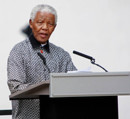
Doug Creighton, the founding Sun publisher, grumbled about me going off to Japan at a busy time. I told him that among the speakers was Nelson Mandela. You can go, he said, if you get an "exclusive" interview. Nuts, I said, and went anyway.
The conference gathered in ancient surroundings in Kyoto near the famous Zen garden where you use a raised walkway to look down on 15 moss-covered stones surrounded by carefully raked gravel. I was walking and staring down and ran right into a big guy who started to fall off the edge. I grabbed Nelson Mandela and saved him. "Migawd," I said, "I just wiped  out the guest speaker."
His bodyguards were furious but Mandela waved them away. Then we all went off to a buffet. I slipped into the line behind Mandela and chatted. His favourite food was porridge, he declared. Then we stood under a tree with our plates and talked some more.
I asked why he was in Japan when his then wife, Winnie, was on trial back in Jo-burg. "We have good lawyers," he said.
My interview was interesting and ran big on Page 2 of the Sun. But I never said it was "exclusive," not with the brass of every major newspaper in the world all around us eager to gab with him at any opportunity.
The next day, Mandela gave the keynote speech. I figured out his exit door and stood there. As he walked by, he said: "Here's the Canadian who hits so hard. What did you think of the speech?"
I said I didn't like it because he hadn't written it himself and it ignored the Zulu, one of the major groups in the future of his troubled country.
"How did you know I didn't write my speech," Mandela demanded. "Because when you got to the end, you turned the page and there wasn't anything there," I told him. He laughed and said I had caught him.  What a great man! He evolved from just another terrorist to a wonderful forgiving leader almost worshipped by his people
 He's been erased by Alzheimer's, unfortunately, so his appearance are few and careful.  It is one interview I will never forget, even though it was only "exclusive" for a few brief moments on a sunny day under a shade tree in the garden of an ancient ruin
'

Saturday, November 5, 2011

2011 CANADIAN DISABILITY HALL OF FAME


ELOQUENT, INSPIRATIONAL, INFLUENTIAL INDUCTEES

I have been a member of the selection board for this wonderful hall since it began in 1993.
But for the first time I have had a bitter taste of the hurdles faced by the 82 members.
When the board met this year to make its choices, I had to send mine in by telephone since at the time I was trapped in Runnymede Health Care Centre, unable to get out of bed or to walk or even stand.
Many of our inductees over the years know exactly what I faced. Except I got over it and they don't.
I learned what their struggles were all about to improve access to public buildings for the disabled, to change the look in a stranger's eyes to understanding rather than a baffled ignorance.
At the induction lunch at the Westin Harbour Castle Hotel, an unfortunate choice I thought as I laboured up 39 steps from the street, we heard great speeches from David Crombie, a song bird among mayors, David Onley, our lieutenant-governor who towers above his wheelchair, and Rick Hansen, the man in motion who has muscled his wheelchair through many lands to, as the program said, move the world to action.
Members of the hall, which used to be called the Terry Fox Hall of Fame until Terry's mother raised constant cranky objections, have transformed this country, founding the CNIB, being leaders in the Paralympics, skiiing their chair to the North Pole, and the list goes on, humbling the rest of us who haven't had to grope or stumble through life.
The latest inductees included Archie Allison, the popular stalwart at Variety Village, a cause dear to the heart of my friend, Doug Creighton, the founder of the Toronto Sun.
 Then there was Benoit Huot, born with a club foot, who failed at hockey and baseball but not as a swimmer, winning eight gold medals, four silver and four bronze in three successive trips to the Paralympics Summer Games. He shrugs it off. "All I've done for 20 years is to look at the bottom of a pool for eight hours a day."
And the McKeever brothers, Brian and Robin. With Robin as his guide, the legally blind Brian has won seven paralympic gold medals, and astounded the world in Vancouver when he also made Canada's Olympic cross-country ski team. He didn't get to race, however, but the brothers handled that with their fine sense of humour. Robin quips that his brother is always following in his footsteps. And Brian says he has learned to meet challenges head on, which occasionally are trees.
However, the best line was delivered by Rick Hansen. He did a bungee jump for Rick Mercer's CBC TV show and said later when he was asked how he felt: "I can't feel my legs."
The luncheon audience roared at that. No doubt everyone returned to their offices and told everyone how awed they had been to learn of the feats of the inductees. As one said, life is not a destination, it's a journey. And they never let disability run them into the ditch.


RATING HYUNDAI ELANTRA TOURING


EXAGGERATED MILEAGE CLAIMS

So I've driven my Hyundai Elantra Touring for more than 2,000 kilometres and know why Canada's car journalists have just called its sedan cousin one of their cars of the year.
I am pleased, but a little irked that once again you can't believe the advertised claims for how much gas a new car model uses.
I really shouldn't be surprised because there have been studies by reputable organizations that show that 99.99% of all claims by car companies about the mileage of their latest models are too low.
Everyone fibs!
In the latest house ad I've seen from Hyundai,  the claim for the Elantra Touring is that highway mileage was 6.4  litres per 100 kilometres or  43 MPG.
The noted car writer Glen Woodcock, my Associate Editor when I was Editor of the Toronto Sun, assures me that you no longer have to break in cars. It used to be that at the start, you were told to drive at various speeds around 110 and not cruise at any one speed, particularly anything over 120.
But I keep my cars for a long time, so I still believe in being careful for the first week or so. So I wasn't roaring around the city and did a sedate 110 on the highway. And I got the claimed 6.4 litres for my first 1,000 km.
Then I did the annual milk run to ensure the cottage was closed properly. At speeds around 100 on the Gardiner and Don Valley, then 116 on 401 and passing at up to 125. Finally 95 or so on roads near the cottage. A similar trip back, except traffic was heavier and I had to use the Lake Shore and its rash of stop lights because the Gardiner was arthritic.
So that was a typical highway trip for me.  And my mileage was 7.9 litres, not that advertised figure at all. Of course Hyundai and the other car companies get the claimed mileage by driving carefully at speeds that would have you rammed on Canadian roads, not under ordinary driving conditions for most drivers.
My main complaint has to do with the ride. I was warned by analysis in Consumer Reports and other publications that the ride was stiff and bumpy. Okay on the highway, but since Toronto streets now resemble something from a city that has been shelled, the ride is certainly a drawback, so much so that if I had been buying a car just for the city,  this would not have been a good choice if I was worried about my back.
I'm happy though, even if I had to take a silver colour rather than the lovely red if I wanted a car without a wait for months. As it was, I got the car a day after my son Mark went back to China, which was one reason why I wanted the car ASAP.
You certainly will find that buyers will pay the price for Hyundai's success, now that the Elantra is challenging to be the top car in Canada in sales. I found the Hyundai dealer on the Lake Shore in Etobicoke to be so indifferent to my business that there wasn't even a reply to a email that I sent.
And the 2011 model were sold out when I went to the dealer on Dufferin. I had to buy a 2012, which was probably a good idea since there are supposed to be significant improvements, except you wouldn't know that from Consumer Reports which still lists its test of a 2009 model on its internet site.
I look forward to years of happy driving, but I certainly will be dodging potholes.


Monday, October 31, 2011

SHRUNKEN HEADS AND SUN TANS


HALLOWEEN MEMORIES AND GREAT RESURRECTIONS

For me, Halloween is a night for ghosts and goblins, shrunken heads, and memories of the biggest gamble in life for my family and me.
It was on Oct. 31, 1971, that 62 of us worked in a shambles of an office to bring out the first Toronto Sun.
I had turned down one secure federal job in Ottawa and even safer municipal job in Toronto to work for less money on a risky tabloid. Was this going to be the resurrection in a new body of  The Telegram, which had always tried to be different and have fun and not play it safe and pushy like the Star?
As I wrote the first of thousands of columns in my tiny study, the youngest of my three sons, Mark, cried as lustily as his three-month-old lungs would allow. And Mary, who never confessed her doubts, tried to keep his rowdy brothers quiet.
My career had been soaring. Was I about to crash, and take my family with me?
Up to that point, Halloween had just been a time to carve clumsy jack-o-lanterns and try to ignore memories of humble Halloweens as a boy in Chesley when all we could afford was to dress me as a ghost under an old sheet with burned cork smeared on my face. No candy when I worked the neighbourhood, but then there wasn't much money either.
The Sun prospered, my doubts withered and the years spun by. The Day Oners tanned in the glow from our Sun. But then shadows came and the original pioneers, and the newspaper itself, shrunk through retirements, deaths, accountants and the wicked witch from Quebec.
Finally the big occasion at this time was for the Worthingtons and Donatos and Downings to gather for anniversary dinners,  to tell grand tales about trips and to boast about what our kids and grandkids were doing.
And I would take a nostalgic stroll past a real ghost house in my own neighbourhood where John Gault and I investigated for days and wrote stories which became front-page sensations in the old and lamented Tely.
Then a couple of years ago, Halloween took on a marvelous edge. Mark had grown up to work for eBay and helped a fascinating man sell a great blue whale's skeleton to a Saudi sheik for a lot of money. Events like that don't happen every day so Mark and the seller, Billy Jamieson, became acquaintances. And Jamieson invited Mark and his parents to his lovely downtown loft where shrunken heads and war clubs adorned the walls and there was a mummy a floor below the haunted fish tank mounted in an old hearse.
Yes, all the words in that paragraph are true.
What a marvelous setting for a costumed Halloween party. You could perch on an electric chair from an American prison and listen to Jamieson tell how you had to make sure you were buying a real shrunken head from long ago and not just from a recent murder victim.
Jamieson's Halloween party was one of the most authentic in the land. If a real ghost had shown up to elbow me aside at the bar, I would not have beens surprised.
This wonderful picture of Jamieson taken by James Ireland captured the crazy mix of showman and explorer that percolated beneath that erratic mane.
The story of Jamieson and how he sold a pharaoh's mummy to Auburn University for $2 million in the stuff of legend, and TV shows too.
I wrote about Jamieson in blogs Come Smell My Shrunken Head, Shrunken Heads And Great Explorations,  Billy Jamieson And His Shrunken Heads, and then, sadly, one marking his death on July 23 this year.
If you wonder about all these references to shrunken heads, I keep making them because the public is fascinated by them. I can tell from the tracking of my blogs that month after month, people make their way via Google to read about one of the most interesting men I have ever met.
As I type this, the door bell keeps ringing and Mary confesses that she's down to the bottom of the baskets to apple juice and granola bars. It's a happy time. The neighbourhood is renewed with kids blossoming among all the old farts.  There have been Halloweens when no one came knocking, no one chanting trick or treat. I always say I want the trick, which baffles the rookie elves and fairy princesses.
I could tell them of a time when the rumour at school the next day was of the occupied outhouse that was pushed over  on to its door, which made exiting messy, to say the least, and all the windows that were soaped on houses and cars belonging to the teachers.
Maybe it happened. Maybe it didn't. So what! Halloweens are an illusion anyway, when kids can yell and make demands of adults and pretend that when they grow up they really will be astronauts or football stars and maybe even a vampire.
It's a time to imagine great things. Because there are only a few like Billy Jamieson who actually do what others only daydream about, to explore ancient ruins and deep jungles and to act like Harrison Ford seeing Petra for the first time.
R.I.P. Billy Jamieson. I have no idea when your birthday was, but it should have been Halloween.

Tuesday, October 18, 2011

EVERYONE BREAKS THIS LAW


 NOTHING LIMITING ABOUT THESE SPEED LIMITS

Two other couples were enjoying an autumn weekend in a B & B with Mary and me when the transmission of my van started acting up. You know, Dodges when they get to 125,000 kms,
So I limped back to Toronto at 100 km/h because the traffic would have run right over the top of me if I had gone slower.
Just another example of how 99% of Ontario drivers drive faster than the speed limit on our highways. Trouble is, they drive at a mixture of speeds because not all of them feel they can trust the unstated deal by the OPP to let you go 116 or so without worry.
I have made the case to three transportation ministers over the years  that when Queen's Park insists on a 100 speed limit on  Highway 401, all it does is encourage scofflawism.  And it is not healthy in a democracy to have too many laws,  bylaws and regulations that everyone ignores.
One of those ministers confessed that if he stuck to the speed limit, his trip to Queen's Park after a weekend in his riding would really be an ordeal.
Strangely enough, some of my colleagues on the Ontario Safety League, a volunteer advisory agency on safety, particularly on the roads, didn't share my views that it is silly to post speeds of 100 when most traffic routinely goes at 115 and a few at  120, and the OPP only pull you over for greater speeds than those, or for erratic driving
What prompts me to return to this chestnut of an issue is that the British Parliament is raising the national speed limit on major roads, which is already 70 mph or 112 km/h, to 80 mph or 128 km/h.
The justification is that the transport ministry says this will be a fiscal improvement because it would reduce travel times.  The minister says that in the four decades since the speed was set at 112, there has been a large decline in fatalities. Officials think that faster legal speeds would be safer too. I'm not sure I would agree with that but the experts say that accidents happen when you have vehicles moving at much different speeds and we certainly get that now.
Environmentalists have rushed to condemn this, saying it will increase fuel consumption. An interesting argument since one could argue that a stream of traffic moving easily at 120 would not be burning much more gas than the present dog's breakfast of different speeds.
For me, the major problem in driving our 400 series of super roads is the rogue 18-wheelers which will ride your bumper in the middle lane even if you're doing 120.
Let the cops pull them over after they see their traumatic stunts, and go after the idiots running at 130  or more, and leave the rest of us to cruise easily and safely at a speed that is definitely not the one that  authorities post.


Saturday, October 15, 2011

SO YOU WANT A PAIN KILLER?


UNHEALTHY RED TAPE

Coming soon to your friendly neighbourhood drugstore is the latest red tape hassle of the Ontario Ministry of Health.
Starting Nov. 1, and right now in some drugstores, identification must be shown to collect prescribed pain killers. You want some Tylenol 3, then you or your spouse better have a driver's licence or government ID or passport or an autographed picture of the health minister.
The first idea was that everyone had to show this identification. Now it's been changed to the person collecting the pain killer if their name isn't on the prescription. Since Mary picks up most of my prescriptions, which is not unusual in families, she will have to deal with this new nuisance.
So what's my objection? Because most of the time it's unnecessary. You give a prescription from your doctor or clinic to your druggist. Often the name and address of your doctor, your personal details and those of your family, are already stored in the drugstore's computers. The pharmacist checks the prescription to see if it is valid, and 15 minutes or so later,  and it definitely will be longer thanks to this new red tape, you get your pills and you ease your pain.
Barry Phillips, the druggist who runs the Shoppers at Bloor and Royal York,  has a form to be filled out by his staff for each prescription - while you stand in the queue and fume - and that form must be kept for two years.
 Naturally he and all pharmacists are annoyed at this latest snarl of red tape. After all, the druggist has to be satisfied that it is your prescription to fill it in the first place. The prescription would be rejected or your name and your doctor would be double checked if there is any suspicion.
 Demanding and recording identification at the end of the process is just a waste of time and paper since the original prescriptions have always been kept for two years.
It's not just the pharmacists who are upset. My GP, Bernie Gosevitz, one of the world's best doctors, tells me that doctors are upset too by the new red tape.
Twelve pages of information have been provided by the government. Of course the Ontario Public Drugs Program Division has to do things like that to justify its existence in the costly health system of Ontario which devours around 43% if the provincial budget.
The first justification is to provide education and raise public awareness about the safe use of these drugs. Except that's the job of the prescribing doctor.
The government says there has been a 41% increase in narcotic-related deaths in Ontario following the addition of long-acting oxycodone to the Ontario Drug Benefits Formulary. So all those pensioners out there who are eliminating their chronic pain by getting almost free drugs thanks to the province will no longer die because they or a relative showed their driver's licence  to a pharmacist.
The government tells us that prescription narcotics are a lucrative street commodity for individuals and organized crime. There have also been a significant increase in pharmacy robberies. So showing a  licence to get Tylenol 3 is going to reduce robberies and alley sales.
It's a little like the government is going to reduce car thefts by demanding drivers show their licence before they buy gas.
At least it gave me something to talk about with Phillips other than the inability of the police, city hall and parking officers to control the illegal parking by cabs at his back door. His wheelchair ramp is often blocked by cabs clustered at the Royal York subway station. The same cabs also block you when you try to back out of the metered parking. They are a problem every daylight minute.
Yet 22 police division, Councillor Peter Milczyn and the zealot parking enforcement officers are incapable of unsnarling a main entrance to a store which has many customers who find it difficult to manoeuvre around the cabs.
But the same parking officers will swoop down like vultures if you are a minute too soon or too late for whatever petty bylaw they are enforcing. It doesn't matter if it's very early or very late, you get tagged but the cabbies sit there handicapping a busy lane.
I am sure that authorities will bring out the handcuffs if you dare show up with a prescription that doesn't match the latest dictates of the Ontario Ministry of Health and Long-Term Care
Wouldn't it be nice if the ministry concentrated on solving the present crisis in hospital care rather than twiddling their thumbs and looking for bogeymen among ordinary Joes and Janes!